
Navigating Autism Therapies: Understanding ABA, OT, and Speech Therapy
*Written with the supervision of Renee Hacker, RBA, Clinical Director at LRCSS.
When your child receives an autism diagnosis, one of the first things you’re handed is a long list of acronyms: ABA, OT, SLP.
It can feel overwhelming to figure out what each professional does, which service your child needs first, and how they all fit together. To help you make informed decisions for your family, let's break down the differences between Applied Behaviour Analysis (ABA), Occupational Therapy (OT), and Speech-Language Pathology (SLP), explore how they work together, and look at how these professions are regulated in Ontario.
1. What’s the Difference? (And How to Choose)
While all three therapies aim to help your child thrive, they approach development through distinct lenses:
| Feature | Applied Behaviour Analysis (ABA) | Occupational Therapy (OT) | Speech-Language Pathology (SLP) |
|---|---|---|---|
| Core Focus | Behaviour & Function: Understanding how the environment influences learning and behaviour. | Functional Daily Living: Fine/gross motor skills, sensory processing, and daily routines. | Communication: Receptive, expressive, and social language, plus feeding/swallowing. |
| Primary Goal | Build adaptive skills and reduce behaviours that impact safety or learning. | Enable independence in daily "occupations" (playing, dressing, writing, self-regulation). | Help children express needs, understand others, use communication tools (AAC), and socialize. |
| Common Strategies | Skill breakdowns, positive reinforcement, prompt hierarchies. | Sensory integration, task adaptation, environmental modifications, motor practice. | Targeted play, social coaching, speech mechanics, alternative communication systems. |
How Do You Know Which to Choose First?
Every child’s developmental profile is unique. Here is a general guide to help you decide where to focus:
Consider ABA if: Your child exhibits behaviours that impact safety (such as elopement or self-injury), struggles to learn skills in traditional environments, or needs structured support to build foundational habits like toilet training or waiting.
Consider OT if: Your child struggles with sensory integration (over- or under-sensitive to sound, textures, or movement), has difficulty with fine motor tasks (holding utensils, zippers, writing), or struggles with emotional self-regulation during daily routines.
Consider SLP if: Your child is non-speaking, experiences delays in understanding or using spoken language, needs support with alternative communication devices (AAC), or experiences difficulties with chewing, swallowing, or picky eating.
At Lake Ridge Community Support Services we specialize in individualized, evidence-based behavioural services. We use ABA to help our clients with a broad range of goals supporting emotional regulation, communication and social skills alongside safety and daily living habits. Our ability to identify and reinforce the factors that shape behaviours help translate skills into new habits and generalize them across different environments. Learn more about the goals we support here.
2. The Power of the Multidisciplinary Team
While each discipline has its own focus, they share a common foundation: they are child-centered, goal-oriented, and rely heavily on family involvement.
Rather than choosing just one, many families find that a combination of therapies yields the best outcomes. When these professionals collaborate, they treat the whole child:
Co-Treatments: An OT and an SLP might run a joint session. The OT helps regulate the child’s sensory system (for example, through swinging or heavy work), putting the child in an ideal state to practice speech-language goals with the SLP.
Behavioural Integration: An ABA therapist can help implement behavioural support plans during OT or SLP sessions, helping a child build stamina and engagement during fine-motor or speech exercises.
Unified Communication: An SLP might design an Augmentative and Alternative Communication (AAC) system, while the OT and ABA teams actively integrate that same communication tool into daily sensory routines and behavioural strategies.
When does your child need more than one? Multi-disciplinary therapy is beneficial when challenges overlap. For instance, if sensory overload (an OT area) triggers distress (an ABA area) that prevents functional communication (an SLP area), having a unified team ensures everyone addresses the root cause together.
At LRCSS, our team often works alongside the above professionals, educators and other support staff to help reinforce skills in our sessions.
3. Regulation, Qualifications, and Ethical Standards in Ontario
When choosing clinicians for your child, it’s vital to know that they are qualified and legally accountable. In Ontario, all three fields are strictly regulated to protect families and maintain high ethical standards.
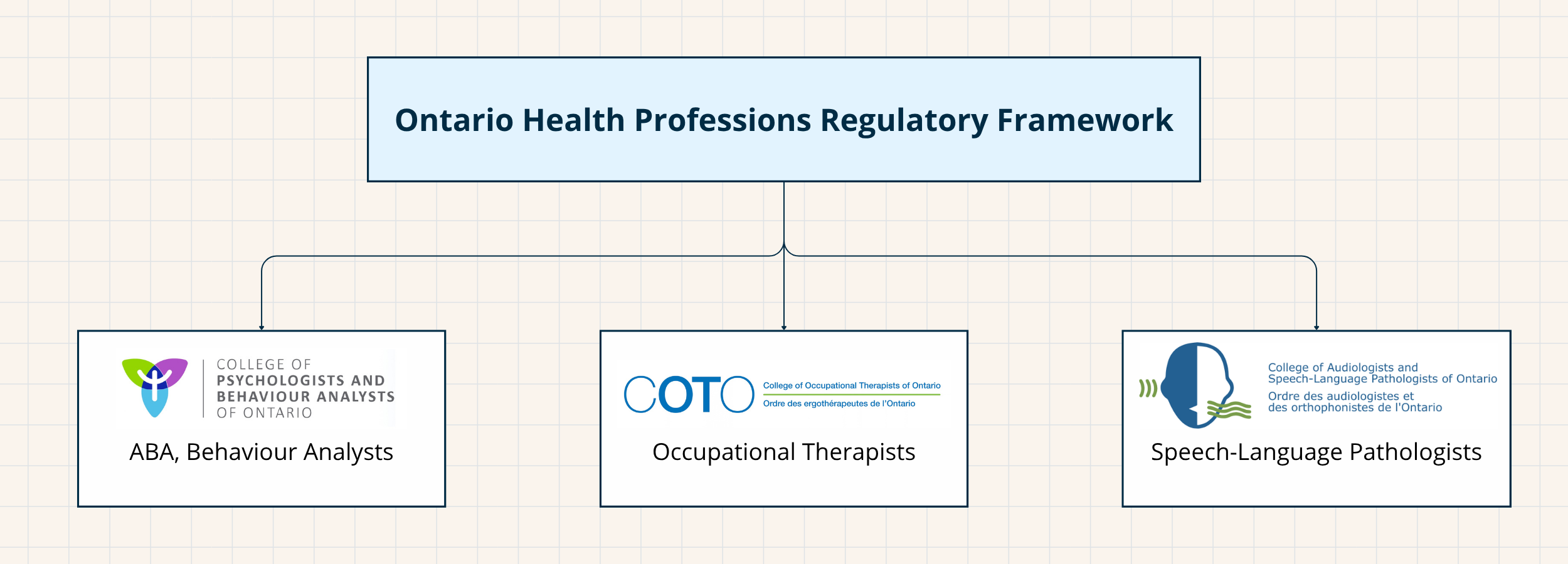
Here is how these professions are credentialed in Ontario:
Applied Behaviour Analysis (ABA)
Regulatory Body: College of Psychologists and Behaviour Analysts of Ontario (CPBAO). Regulated under the Psychology and Applied Behaviour Analysis Act, 2021.
Qualifications: Master’s degree in Applied Behaviour Analysis or a related field, along with a minimum of 1,500 hours of supervised clinical practice.
Ongoing Ethics: Practitioners must pass the provincial entry exam, register with the CPBAO, participate in quality assurance programs, and adhere to strict ethical guidelines to maintain their registration.
At LRCSS we have 41* Registered Behaviour Analysts (RBAs) on our team certified by the CBBAO. Learn more about who provides ABA in Ontario and LRCSS here.
Occupational Therapy (OT)
Regulatory Body: College of Occupational Therapists of Ontario (COTO). Regulated under the Regulated Health Professions Act, 1991 (RHPA).
Qualifications: Master’s degree in Occupational Therapy and a minimum of 1,000 hours of supervised clinical placement.
Ongoing Ethics: Practitioners must pass the National Occupational Therapy Certification Examination (NOTCE), maintain liability insurance, and participate annually in COTO’s Quality Assurance Program.
Speech-Language Pathology (SLP)
Regulatory Body: College of Audiologists and Speech-Language Pathologists of Ontario (CASLPO). Regulated under the Regulated Health Professions Act, 1991 (RHPA).
Sources Summary
College of Psychologists and Behaviour Analysts of Ontario (CPBAO): Governing body regulating Behaviour Analysts and Psychologists under the Psychology and Applied Behaviour Analysis Act, 2021.
College of Occupational Therapists of Ontario (COTO): Regulatory authority establishing standards of practice, entry requirements, and ethical guidelines for OTs in Ontario under the Occupational Therapy Act, 1991.
College of Audiologists and Speech-Language Pathologists of Ontario (CASLPO): Regulatory body overseeing standards, licensing, and public protection for SLPs and Audiologists under the Audiology and Speech-Language Pathology Act, 1991.
Ontario Association for Behaviour Analysis (ONTABA): Professional association advocating for the field and supporting practitioners through education and resources.