
Just Received an Autism Diagnosis in Ontario? Here Is Your Step-by-Step Roadmap (Beyond the OAP Waitlist)
*Written with the supervision of Renee Hacker, Registered Behaviour Analyst (RBA), Clinical Director
Receiving an autism spectrum disorder (ASD) diagnosis for your child brings a mix of emotions: relief at having answers, grief for the path you imagined, and overwhelming fear about what to do next.
If you are currently sitting at your kitchen table staring at a diagnostic report, take a deep breath. You do not need to figure out the next eighteen years today. You only need to know what to do next. While almost every professional will tell you to "register for the OAP," registering is only one track of a larger roadmap. Because waitlists for Core Clinical Services under the Ontario Autism Program (OAP) can take time, relying solely on OAP registration can leave your family stranded. Here is the exact, step-by-step roadmap built by clinical experts and parents with lived experience to protect your child’s development and your family's financial and emotional well-being.
Track 1: Register for the Ontario Autism Program (OAP)
Immediately Registering for the OAP establishes your child’s place on the provincial waitlist for funded Core Clinical Services (such as Applied Behaviour Analysis, Speech-Language Pathology, and Occupational Therapy).
Action Steps:
Gather Documents: You will need your child’s Ontario Health Card number and the official diagnostic assessment report signed by a qualified practitioner (psychologist, pediatrician, or psychiatrist).
Submit Online:** Create or log into your AccessOAP account and complete the registration.
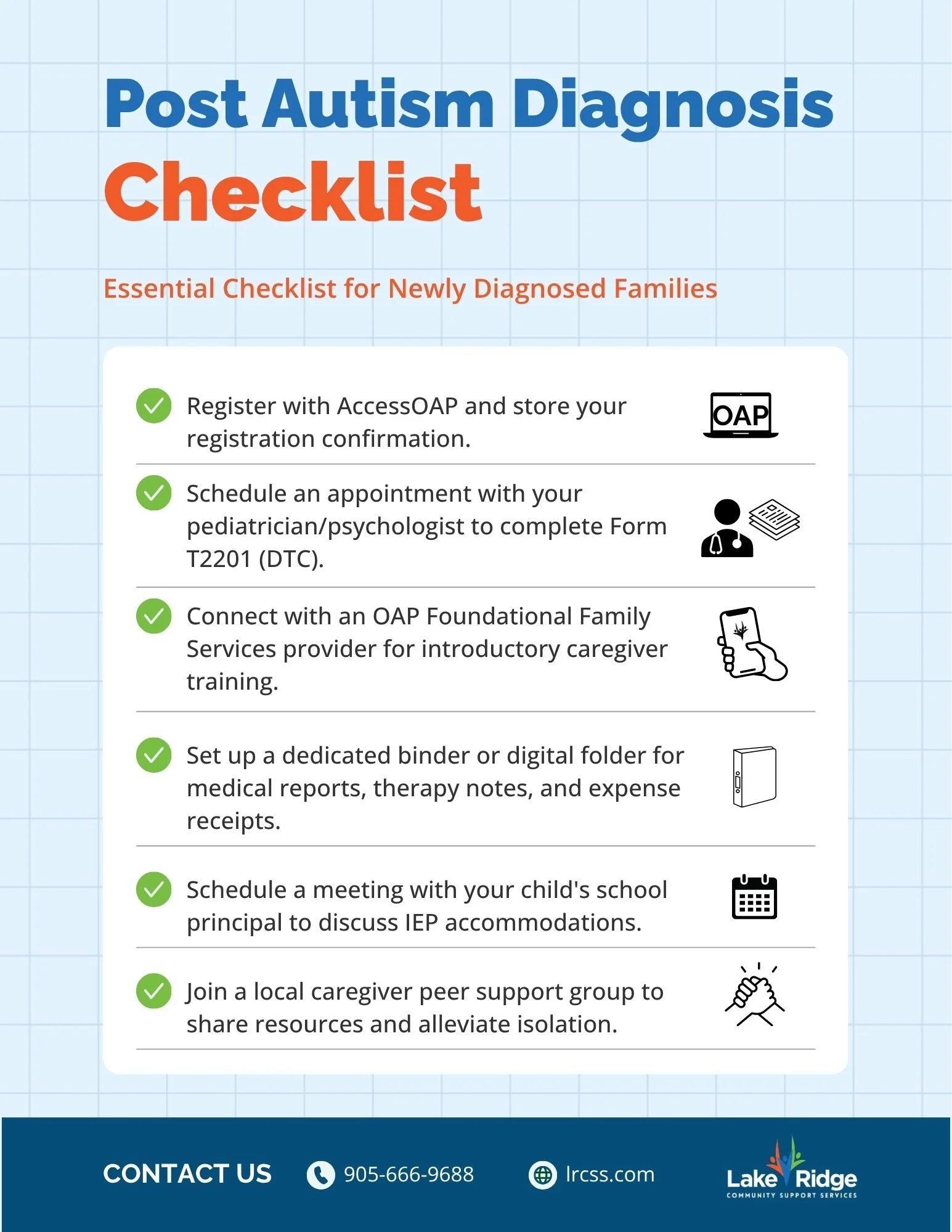
Save Your Confirmation: Keep your OAP registration number and confirmation letter in an easily accessible folder.
Lived Experience Insight: According to advocacy groups and experienced families don't wait until you have every secondary report, school assessment, or follow-up evaluation in hand to submit your OAP application. As soon as your clinician hands you the signed diagnostic confirmation letter containing DSM-5 criteria, submit it to AccessOAP immediately to lock in your waitlist position. Every week you wait to submit is a week added to your waitlist time.
Track 2: Unlock Financial Supports (DTC, CDB, and RDSP)
Many families assume financial aid is tied to the OAP waitlist. In reality, federal and provincial tax systems provide substantial funding regardless of your OAP status.
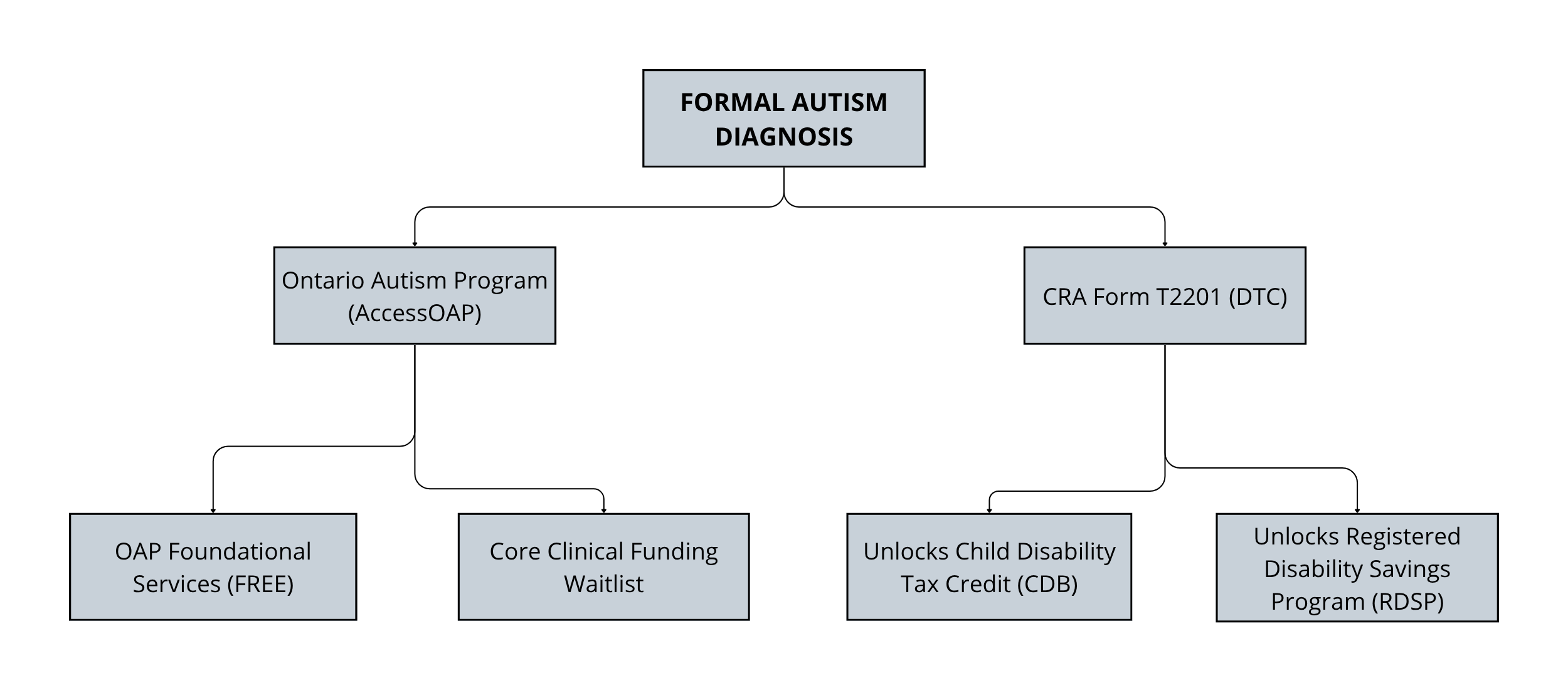
1. Apply for the Disability Tax Credit (DTC) — CRA Form T2201: The DTC is a non-refundable tax credit that reduces the income tax paid by supporting family members.
Key Detail: The CRA assesses functional limitations in daily living (adaptive functioning, focus, social interactions, safety awareness) rather than the diagnosis alone.
Retroactive Claims: You can request adjustments for up to 10 prior tax years, which can result in significant retroactive refunds.
2. Automatic Child Disability Benefit (CDB): Once approved for the DTC, families eligible for the Canada Child Benefit (CCB) automatically receive the Child Disability Benefit—a tax-free monthly payment that helps cover therapies, respite, or specialized tools while waiting for OAP funding.
3. Open a Registered Disability Savings Plan (RDSP): Approval for the DTC unlocks the RDSP, a long-term growth tool where the Government of Canada provides matching grants up to $3,500 annually (up to a lifetime maximum of $70,000 in grants and $20,000 in bonds), depending on family income.
Track 3: Access Immediate Community & Interim Services
If your child is attending or preparing for school, early advocacy is critical.
Notify the School Principal: Request an initial meeting to discuss your child's diagnostic assessment and functional strengths and needs.
Individual Education Plan (IEP): Work with the school team to write an IEP within 30 school days of placement. This documents accommodations, modified expectations, and specialized support.
IPRC (Identification, Placement, and Review Committee): Formally identify your child under the exceptionality of Autism to protect their access to special education resources.
Essential Checklist for Newly Diagnosed Families
Navigating Next Steps with Confidence
An autism diagnosis brings challenges, but you do not have to navigate them alone. Taking action across these parallel paths ensures your child gets available resources today while building long-term financial stability.
Ready to simplify your OAP application?
Read our detailed breakdown on Understanding Ontario Autism Program (OAP) Funding and Application Guide to step confidently through the registration process.