
Note: This post was written by our Marketing Manager in collaboration with and under the supervision of Davidy Maidany, Registered Behavior Analyst (RBA), Program Manager at LRCSS.
For many neurotypical children, a school day is structured around learning, social connections, and play. But for a child with autism or an individual with an intellectual disability, the average classroom can feel like a high-intensity sensory and cognitive minefield.
When a child returns home from school and experiences an intense emotional meltdown or completely shuts down, it is rarely a sign of willingness or intentional "bad behavior." Instead, it is often the direct result of a nervous system that has been pushed past its capacity.
At Lake Ridge Community Support Services (LRCSS), our mission is to help individuals with autism and intellectual disabilities thrive in a world that wasn't designed for them. To do that, we must look at the school environment through an autism lens—reframing behaviours as natural responses to unmet needs and environmental barriers.
Unpacking the Environmental Friction Points
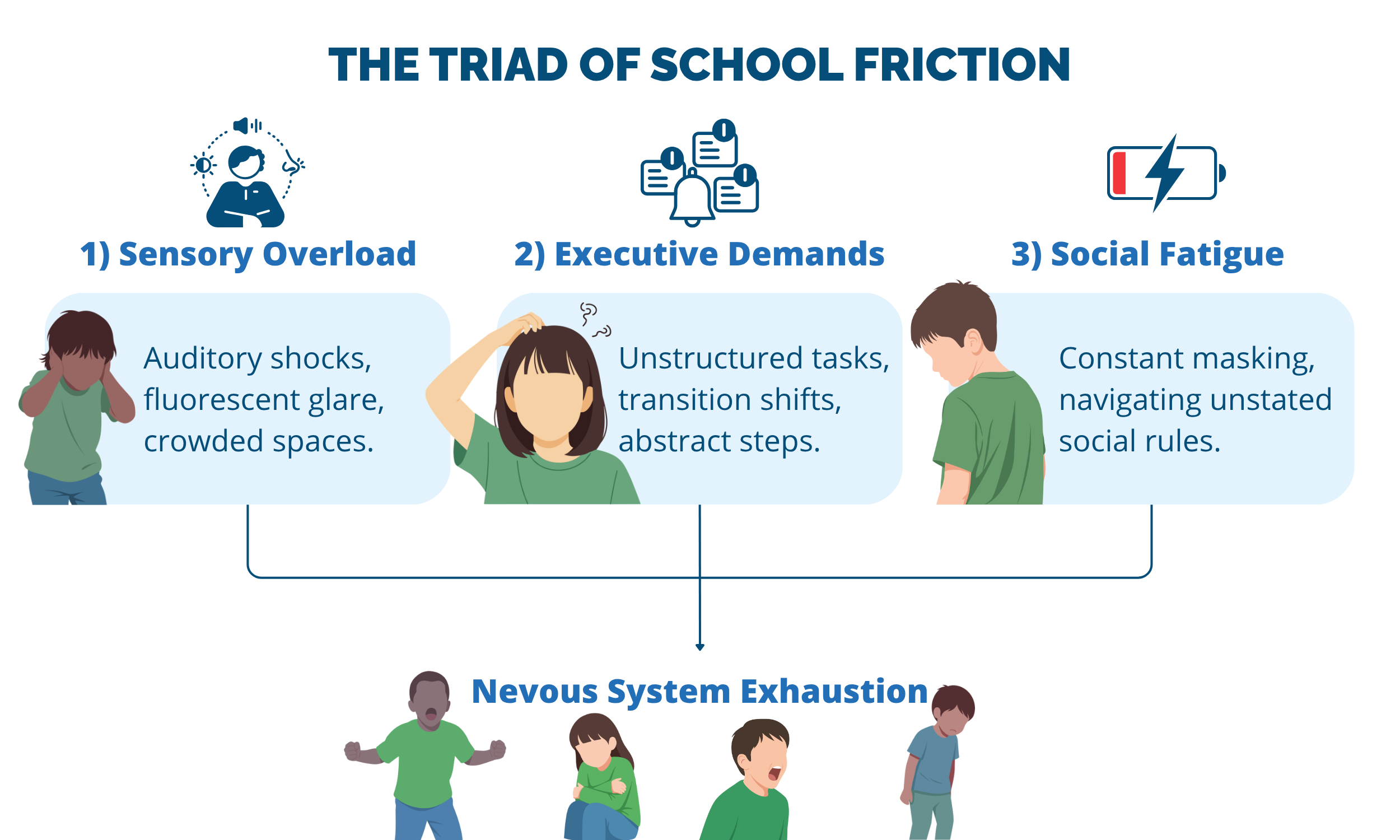
The modern school day introduces friction across three core areas:
The Triad of School Friction
Sensory Overload (The Built Environment): High-decibel environments like cafeterias and gymnasiums, scraping chair legs on tile floors, pulsing fluorescent lighting, and crowded hallways continuously overwhelm hyper-sensitive processing systems.
Cognitive & Executive Function Load: Navigating fluid timetables, switching rapidly between tasks, and interpreting broad directives (e.g., "get ready for recess") require intense mental effort.
The "Hidden Curriculum" & Social Masking: Students often spend their day "fawning" or masking their natural responses to fit in, leading to the "Coke Bottle Effect"—where all the shaken-up pressure from the day explodes once they finally reach the safety of home.
Proactive IEP Accommodations That Protect Regulatory Bandwidth
True inclusion does not mean forcing a child to simply adapt to an overwhelming environment; it requires adjusting the environment so the child can participate meaningfully. Under Ontario’s special education framework, an Individual Education Plan (IEP) should proactively include concrete accommodations so students do not have to advocate for themselves while already in a state of distress.
Below is a list of potential accommodations that could benefit your child. It’s important to note this list is not exhaustive and every child is unique. The ideal accommodations are built in collaboration with your child, their support system and the school itself.
Evidence-Based ABA Strategies to Build Predictability
Applied Behavior Analysis (ABA) provides practical tools to reduce transition friction and build confidence. Rather than using behavioural tools for rigid compliance, we use them as bridges to help children access their learning environment comfortably:
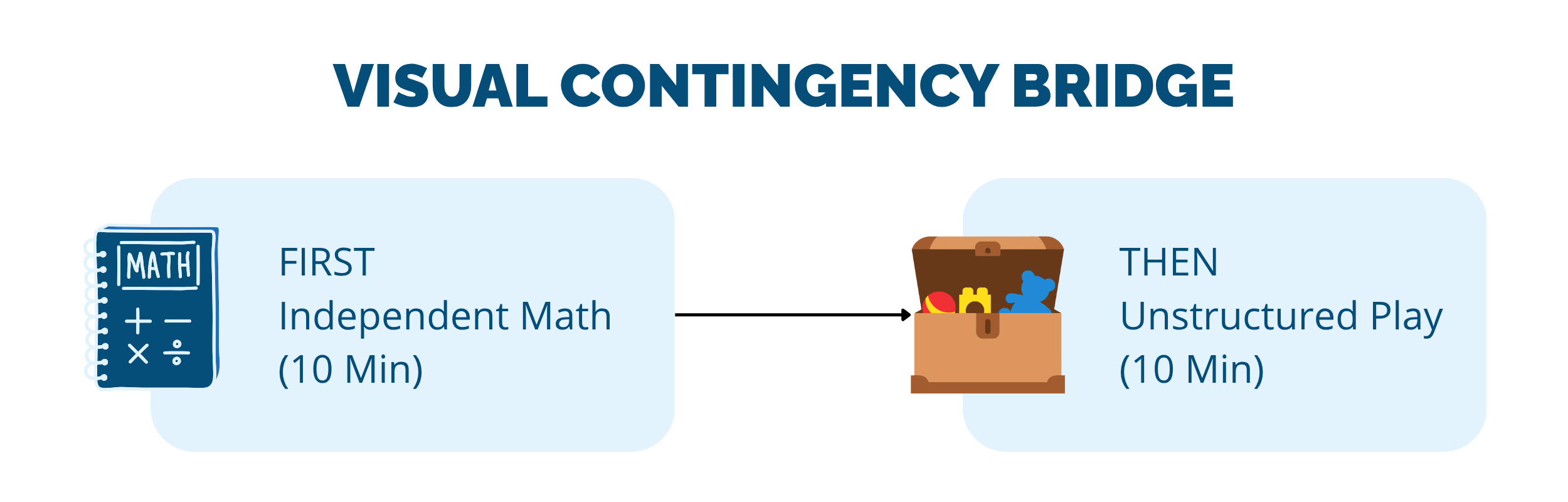
Visual Schedules & First-Then Boards: Abstract concepts of time are converted into concrete visual paths. Showing a student First [Task], Then [Preferred Activity] clarifies expectations and builds motivation.
Transition Warnings & Timers: Advance notice paired with visual timers gives predictable structure, easing set-shifting anxiety before routine switches happen.
Wait Cards: Visual cues indicating an item or activity is temporarily unavailable make waiting predictable by providing a clear, visible promise of future access.
Advocating for Your Child’s Right to Inclusive Learning
As parents and caregivers, you are your child’s most important advocate. Understanding the distinction between an Identification, Placement, and Review Committee (IPRC); which legally determines exceptionality and placement) and an IEP (the fluid working document mapping out daily accommodations and goals) empowers you to collaborate effectively with educators.
Remember: Inclusion is a two-way street. While children work hard to develop new coping skills, our schools and communities must also grow in accessibility, understanding, and support.
How LRCSS Supports Your Family’s Education Journey
You don’t have to navigate the school system alone. LRCSS offers tailored supports designed for every stage of your journey:
Navigating the Education System Workshop: A comprehensive Foundational Family Service breaking down Ontario's IPRC and IEP processes to help you advocate effectively.
Transition to Kindergarten Workshop: An on-demand workshop in our Foundations Portal focused on routine readiness and practical transition tools.
Brief Targeted Consultations: Speak 1-on-1 with a Behaviour Technician to tackle specific school challenges and receive personalized strategies.
Individualized ABA Services: Focused support to build school readiness, self-advocacy, and emotional regulation skills tailored to your child’s unique goals.
Peer-Reviewed Academic & Clinical Sources that shape this and other topics on navigating the school with autism.
Behavioural Psychology & Educational Research
Brewer, A., Pressley, A. L., & Dunlap, G. (2014). Transition warnings and behavioral supports for children with autism spectrum disorder. Journal of Positive Behavior Interventions, 16(3), 145–155.
Chan, J. M., & O’Reilly, M. F. (2008). A social story intervention package to increase social communication and decrease inappropriate behavior of two young children with autism spectrum disorder in inclusive classrooms. Journal of Autism and Developmental Disorders, 38(10), 1877–1888.
Fontil, L., Sladeczek, I. E., Gfroerer, S., & Geva, S. (2019). School readiness and the transition to kindergarten for children with autism spectrum disorder: Preparing families and schools. Early Childhood Education Journal, 47(4), 425–435.
Gray, C. A., & Garand, J. D. (1993). Social Stories: Improving social understanding in children with autism. Focus on Autistic Behavior, 8(1), 1–10.
Knight, V. F., Sartini, E., & Spriggs, A. D. (2014). Evaluating visual schedules for students with autism spectrum disorder: A meta-analysis. Journal of Autism and Developmental Disorders, 44(1), 160–174.
Kokina, A., & Kern, L. (2010). Social Story™ interventions for students with autism spectrum disorders: A meta-analysis. Journal of Autism and Developmental Disorders, 40(7), 812–826.
MacDonald, K. R., & Hummel, J. H. (2018). Implementation of visual schedules in early childhood classrooms for children with autism. Focus on Autism and Other Developmental Disabilities, 33(2), 89–98.
Mesibov, G. B., Shea, V., & Schopler, E. (2005). The TEACCH Approach to Autism Spectrum Disorders. Springer Science & Business Media.
Sharma, S., & Dunlap, G. (2008). The use of wait cards to decrease problem behaviors in young children with autism during transition periods. Topics in Early Childhood Special Education, 28(2), 94–103.
Sy, J. R., Grindle, C. F., & Hastings, R. P. (2014). Increasing instruction-following and task engagement in children with autism during classroom transitions. Behavior Analysis in Practice, 7(1), 22–31.
Neuroscience & Cognitive Psychology
Frith, U., & Happé, F. (1994). Autism: Beyond "theory of mind". Cognition, 50(1-3), 115–132. (Source for Weak Central Coherence Theory)
Gilbert, S. J., Bird, G., Brindley, R., Frith, C. D., & Burgess, P. W. (2008). Atypical activation of medial prefrontal cortex in autism spectrum conditions during social and non-social tasks. Brain, 131(4), 869–878.
Hill, E. L. (2004). Executive dysfunction in autism. Trends in Cognitive Sciences, 8(1), 26–32.
Markram, H., & Markram, K. (2010). The Intense World Theory – a unifying neurofunctional theory of autism. Frontiers in Human Neuroscience, 4, 224. (Source for sensory gating and hyper-reactivity mechanisms)